2.3. Exercises#
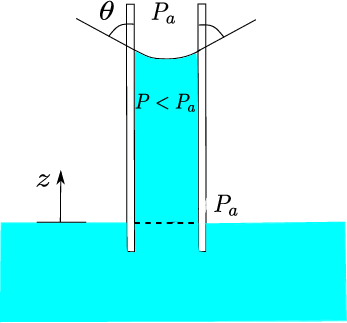
Let \(\theta\) be the contact angle at the interface between air, liquid, and solid;
let \(\gamma\) be the surface tension between air and liquid; let \(\rho\) be the density of the liquid.
Determine the height \(h\) of the liquid column in a cylindrical tube of radius \(r = 0.5 \ mm\) relative to the level
in the reservoir. Then calculate the pressure inside the column.
(It can be assumed that the pressure acting on the reservoir and on the top surface of the liquid in the tube is the same.)
Assume thermodynamic conditions and tube material such that:
if the liquid is water: \(\rho = 999 \ kg/m^3\), \(\theta={1}^\circ\), \(\gamma=0.073 \ N/m\).
if the liquid is mercury: \(\rho = 13579 \ kg/m^3\), \(\theta={140}^\circ\), \(\gamma=0.559 \ N/m\).
(\(h_{H_2O} = 2.97 \ cm\), \(P_{H_2O} - P_0 = - 291.95 \ Pa\); \(h_{Hg} = -1.28 \ cm\), \(P_{Hg} - P_0 = 1712.87 \ Pa\))
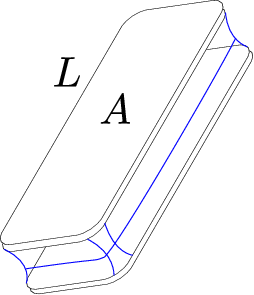
Two identical flat parallel plates are separated by a distance \(d\).
A thin layer of liquid is present between the plates. The surface area \(A\) and perimeter \(L\)
of the two plates are known, as well as the ambient pressure \(p_a\), the surface tension \(\gamma\)
of the liquid, and the contact angle \(\theta\).
Determine the component of the force acting perpendicular to the plates on each of them.
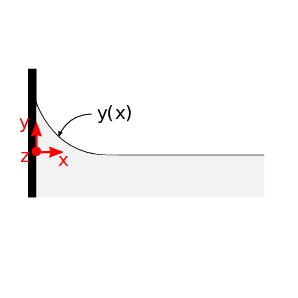
Determine the shape of the free surface between air and water, with density \(\rho\),
near an infinite flat wall, given the surface tension \(\gamma\) and the contact angle \(\theta\) at the wall.
The air pressure is uniform and equal to \(P_a\).