
2.3.3. Exercise 2.3#
We want to calculate the shape of the free surface between air and water, of density \(\rho\), near an infinite flat wall, knowing the surface tension \(\gamma\) and the contact angle \(\theta\) at the wall. The air pressure is uniform and equal to \(P_a\).
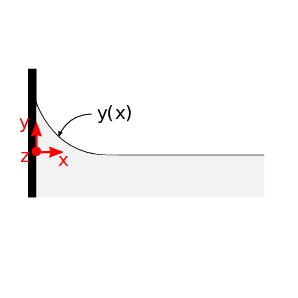
Since the problem is studied near an infinite flat wall, it is reasonable to assume that the solution does not depend on the coordinate describing the wall’s length, namely the \(z\) coordinate (see diagram, TODO). The Young-Laplace equation for a 2D surface in 3D space,
reduces to the case of a 1D surface in 2D space, where the contact surface is flat in the \(z\) direction.
If \(R := R_1\) is the curvature radius in the \(x\)–\(y\) plane and \(R_2\) is the radius in the \(z\)–\(y\) plane, the Young-Laplace equation simplifies to:
since \(R_2 \rightarrow \infty\) — because the surface height does not vary with \(z\) at fixed \(x\) — the radius of curvature in that direction is infinite. We define the curvature \(k := 1/R\).
The pressure in the air is constant, \(P_2 = P_a\). The pressure \(P_1(x)\) in the water at the interface can be calculated using Stevino’s law:
where \(y(x)\) is the height of the free surface, relative to the reference level \(y = 0\), which is chosen such that the water pressure is equal to \(P_a\). Substituting into the Young-Laplace equation gives:
Recall that the curvature of a surface described by \(y(x)\) is given by (TODO: add derivation?):
leading to the nonlinear differential equation governing the free surface shape:
This is the Young-Laplace equation with boundary conditions: one at the wall (\(x=0\)), relating the surface slope to the contact angle, and one at infinity ensuring the surface returns to the flat level where the pressure equals \(P_a\).
Letting \(a^2 := \frac{2\gamma}{\rho g}\), and integrating the equation once, we get:
where \(A\) is the integration constant. To ensure \(y(x\rightarrow\infty) \rightarrow 0\) with a «reasonable smoothness,» we also require \(y'(x\rightarrow\infty) \rightarrow 0\), which implies \(A = 1\).
A second integration of the equation:
yields the analytical solution (TODO: add derivation):
with \(B\) determined from the wall boundary condition.
Remark.
This problem provides an example of how to compute the shape of a fluid interface. Despite being one of the simplest imaginable cases, its analytical solution already requires significant effort. Enthusiasts are invited to compute the interface shape between air and water confined between two vertical walls, by numerically solving the nonlinear differential problem (an analytical solution exists, but is even more “cryptic” than the one derived above):