2.3.2. Exercise 2.2#
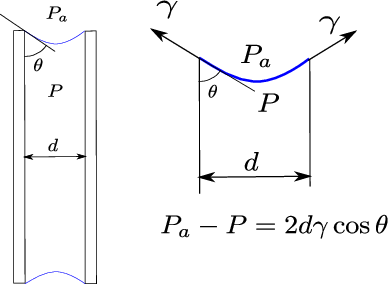
Two equal, parallel flat plates are separated by a distance \(d\).
A thin layer of liquid is present between the plates.
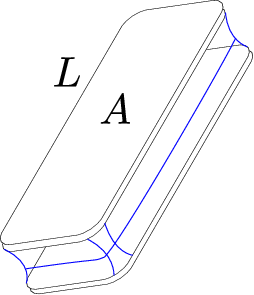
The area of the surfaces \(A\) and the perimeter \(L\) of the plates are known,
as well as the ambient pressure \(p_a\), the surface tension of the liquid \(\gamma\), and the contact angle \(\theta\).
The task is to determine the component of the force acting on each plate that is perpendicular to the plates.
Concepts. Surface tension. Contact angle.
Solution. The setup described in the exercise is an equilibrium condition.
The force acting on a plate is due to two effects: surface tension at the fluid perimeter,
and the pressure difference between the fluid and the ambient.
We consider the force positive if it is attractive.
Calculation of \(F_\gamma\):
\[F_\gamma = \gamma L \sin \theta\]Calculation of \(F_p\). The pressure jump is obtained by applying interfacial equilibrium:
\[F_p = (p_a - p) A\]with:
\[(p_a - p) d = 2 \gamma \cos \theta\]The total requested component is thus:
\[F = \frac{2 \gamma A \cos \theta}{d} + L \gamma \sin \theta\]