
46.8. Optimal control for reference tracking#

In order to get perfect asymptotic tracking of polynomial reference signals with degree \(m\) with optimal control, the original system must be augmented with the dynamical equations of \(m+1\) integral errors. This process is shown for tracking step reference with the augmentation of the original system with a single integrator and for tracking ramp reference with the augmentation with a double integrator.

This procedure is somehow equivalent to the addition of integrators in open-loop transfer function, as discussed in the section about reference tracking as a performance of a closed-loop system.

An example about optimal control for reference tracking in a mass-damper-spring system is shown in the next section, as a Jupyter notebook that can be opened, run, and modified in Colab.

46.8.1. Augmented system for tracking step reference signal - integrator#

Let \(\mathbf{y}_{\text{ref}}\) a reference signal. An augmented system can be defined in order to use optimal control for tracking the desired reference signal.

\[\begin{split}\begin{aligned} \dot{\mathbf{x}} & = \mathbf{A} \mathbf{x} + \mathbf{B} \mathbf{u} \\ \mathbf{y} & = \mathbf{C} \mathbf{x} + \mathbf{D} \mathbf{u} \end{aligned}\end{split}\]

the state-space representation of the plant. Let \(\mathbf{y}_{ref}\) a desired output and the integral error

\[\mathbf{e}(t) := \int_{\tau=0}^{t} \left\{ \mathbf{y}(\tau) - \mathbf{y}_{ref}(\tau) \right\} d \tau \ ,\]

as a new state with dynamical equation

\[\dot{\mathbf{e}} = \mathbf{y}(t) - \mathbf{y}_{ref}(t) = \mathbf{C} \mathbf{x} + \mathbf{D} \mathbf{u} - \mathbf{y}_{ref} \ .\]

The optimal control is applied to the augmented system

\[\begin{split}\underbrace{\begin{bmatrix} \dot{\mathbf{x}} \\ \dot{\mathbf{e}} \end{bmatrix}}_{\dot{\mathbf{z}}} = \underbrace{\begin{bmatrix} \mathbf{A} & \cdot \\ \mathbf{C} & \cdot \end{bmatrix}}_{\hat{\mathbf{A}}} \underbrace{\begin{bmatrix} \mathbf{x} \\ \mathbf{e} \end{bmatrix}}_{\mathbf{z}} + \underbrace{\begin{bmatrix} \mathbf{B} \\ \mathbf{D} \end{bmatrix}}_{\hat{\mathbf{B}}_u} \mathbf{u} + \underbrace{\begin{bmatrix} \cdot \\ -\mathbf{I} \end{bmatrix}}_{\hat{\mathbf{B}}_{ref}} \mathbf{y}_{ref}\end{split}\]

Optimal control framework provides the opitmal gain matrix \(\hat{\mathbf{K}}\), so that \(\mathbf{u} = - \hat{\mathbf{K}} \mathbf{z}\) and the closed loop system becomes

\[\dot{\mathbf{z}} = \left( \hat{\mathbf{A}} - \hat{\mathbf{B}}_u \hat{\mathbf{K}} \right) \mathbf{z} + \hat{\mathbf{B}}_{ref} \mathbf{y}_{ref} \ .\]
\(\lim_{t \rightarrow +\infty} e(t)\)

Transfer function. From the reference signal to the tracking error,

\[\mathbf{e}(s) = \mathbf{y}_{\text{ref}} - \mathbf{G}_k(s) \frac{\mathbf{e}}{s}\]
\[\mathbf{e}(s) = \left[ \mathbf{I} + \frac{1}{s} \mathbf{G}_k(s) \right]^{-1} \mathbf{y}_{\text{ref}}(s)\]

Final value theorem.

\[\lim_{t \rightarrow +\infty} \mathbf{e}(t) = \lim_{s \rightarrow 0} s \mathbf{e}(s)\]

Let \(\mathbf{y}_{\text{ref}}\) a polynomial reference input, \(\mathbf{y}_{\text{ref}} = \mathbf{C}_{-1} \delta(t) + \sum_{k=0}^{m} \mathbf{C}_k t^k\) then its Laplace transform reads \(\mathbf{y}_{\text{ref}}(s) = \sum_{k=-1}^{m} \frac{\mathbf{C}_k}{s^{k+1}}\)

\[\begin{split}\begin{aligned} \lim_{t \rightarrow +\infty} \mathbf{e}(t) & = \lim_{s \rightarrow 0} s \mathbf{e}(s) = \\ & = \lim_{s \rightarrow 0} s \left[ \mathbf{I} + \frac{1}{s} \mathbf{G}_k(s) \right]^{-1} \left( \sum_{k=-1}^{m} \frac{\mathbf{C}_k}{s^{k+1}} \right) = \\ & = \lim_{s \rightarrow 0} s \cdot s \, \mathbf{G}_k^{-1}(s) \left( \sum_{k=-1}^{m} \frac{\mathbf{C}_k}{s^{k+1}} \right) \ , \end{aligned}\end{split}\]

and thus, if

  • \(m = 0\) (i.e. linear combination of Dirac’s delta and a step) the asymptotic value of the tracking error is zero;

  • \(m = 1\) (i.e. up to a ramp) the asymptotic value of the tracking error is constant, \(\mathbf{G}_k^{-1}(0) \mathbf{C}_1\);

  • \(m > 1\) the tracking error goes to infinity.
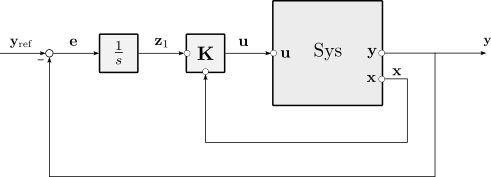
Optimal control. Reference tracking for step

Fig. 46.2 Caption#

46.8.2. Augmented system for tracking ramp reference signal - double integrator#

Let \(\mathbf{y}_{\text{ref}}\) a reference signal. An augmented system can be defined in order to used optimal control. Let

\[\begin{split}\begin{aligned} \dot{\mathbf{x}} & = \mathbf{A} \mathbf{x} + \mathbf{B} \mathbf{u} \\ \mathbf{y} & = \mathbf{C} \mathbf{x} + \mathbf{D} \mathbf{u} \end{aligned}\end{split}\]

the state-space representation of the plant. Let \(\mathbf{y}_{ref}\) a desired output and the integral error

\[\mathbf{e}_1(t) := \int_{\tau=0}^{t} \left\{ \mathbf{y}(\tau) - \mathbf{y}_{ref}(\tau) \right\} d \tau \ ,\]

as a new state with dynamical equation

\[\dot{\mathbf{e}}_1 = \mathbf{y}(t) - \mathbf{y}_{ref}(t) = \mathbf{C} \mathbf{x} + \mathbf{D} \mathbf{u} - \mathbf{y}_{ref} \ .\]

The second augmenting state is defined as

\[\mathbf{e}_2(t) := \int_{\tau=0}^{t} \mathbf{e}_1(\tau) \, d\tau \ ,\]

so that the dynamical equation is

\[\dot{\mathbf{e}}_2 = \mathbf{e}_1 \ .\]

The optimal control is applied to the augmented system

\[\begin{split}\underbrace{\begin{bmatrix} \dot{\mathbf{x}} \\ \dot{\mathbf{e}}_1 \\ \dot{\mathbf{e}}_2 \end{bmatrix}}_{\dot{\mathbf{z}}} = \underbrace{\begin{bmatrix} \mathbf{A} & \cdot & \cdot \\ \mathbf{C} & \cdot & \cdot \\ \cdot & \mathbf{I} & \cdot \end{bmatrix}}_{\hat{\mathbf{A}}} \underbrace{\begin{bmatrix} \mathbf{x} \\ \mathbf{e}_1 \\ \mathbf{e}_2 \end{bmatrix}}_{\mathbf{z}} + \underbrace{\begin{bmatrix} \mathbf{B} \\ \mathbf{D} \\ \cdot \end{bmatrix}}_{\hat{\mathbf{B}}_u} \mathbf{u} + \underbrace{\begin{bmatrix} \cdot \\ -\mathbf{I} \\ \cdot \end{bmatrix}}_{\hat{\mathbf{B}}_{ref}} \mathbf{y}_{ref}\end{split}\]

Optimal control framework provides the opitmal gain matrix \(\hat{\mathbf{K}}\), so that \(\mathbf{u} = - \hat{\mathbf{K}} \mathbf{z}\) and the closed loop system becomes

\(\lim_{t \rightarrow +\infty} e(t)\)

Transfer function. The closed-loop system reads

\[\begin{split}\begin{aligned} s \mathbf{x} & = \mathbf{A} \mathbf{x} + \mathbf{B} \mathbf{u} = \\ & = \left( \mathbf{A} - \mathbf{B} \mathbf{K} \right) \mathbf{x} - \mathbf{B} \mathbf{K}_1 \mathbf{z}_1 - \mathbf{B} \mathbf{K}_2 \mathbf{z}_2 \\ \mathbf{y} & = \left( \mathbf{C} - \mathbf{D} \mathbf{K}_u \right) \mathbf{x} - \mathbf{D} \mathbf{K}_1 \mathbf{z}_1 - \mathbf{D} \mathbf{K}_2 \mathbf{z}_2 \ . \end{aligned}\end{split}\]

so that

\[\begin{split}\begin{aligned} \mathbf{x} & = \left( s \mathbf{I} - \mathbf{A} + \mathbf{B} \mathbf{K} \right)^{-1} \left[ - \mathbf{B} \mathbf{K}_1 \mathbf{z}_1 - \mathbf{B} \mathbf{K}_2 \mathbf{z}_2 \right] = \\ & = \dots \end{aligned}\end{split}\]

and \(\mathbf{y} = \mathbf{G}_1(s) \mathbf{K}_1 \mathbf{z}_1 + \mathbf{G}_2(s) \mathbf{K}_2 \mathbf{z}_2\).

From the reference signal to the tracking error,

\[\begin{split}\begin{aligned} \mathbf{e}(s) & = \mathbf{y}_{\text{ref}} - \mathbf{y} = \\ & = \mathbf{y}_{\text{ref}} - \mathbf{G}(s) \mathbf{K}_1 \mathbf{z}_1 - \mathbf{G}(s) \mathbf{K}_2 \mathbf{z}_2 = \\ & = \mathbf{y}_{\text{ref}} - \mathbf{G}_1(s) \frac{\mathbf{e}}{s} - \mathbf{G}_2(s) \frac{\mathbf{e}}{s^2} \ , \end{aligned}\end{split}\]
\[\mathbf{e}(s) = \left[ \mathbf{I} + \frac{1}{s} \mathbf{G}_1(s) + \frac{1}{s^2} \mathbf{G}_2(s) \right]^{-1} \mathbf{y}_{\text{ref}}(s)\]

Final value theorem.

\[\lim_{t \rightarrow +\infty} \mathbf{e}(t) = \lim_{s \rightarrow 0} s \mathbf{e}(s)\]

Let \(\mathbf{y}_{\text{ref}}\) a polynomial reference input, \(\mathbf{y}_{\text{ref}} = \mathbf{C}_{-1} \delta(t) + \sum_{k=0}^{m} \mathbf{C}_k t^k\) then its Laplace transform reads \(\mathbf{y}_{\text{ref}}(s) = \sum_{k=-1}^{m} \frac{\mathbf{C}_k}{s^{k+1}}\)

\[\begin{split}\begin{aligned} \lim_{t \rightarrow +\infty} \mathbf{e}(t) & = \lim_{s \rightarrow 0} s \mathbf{e}(s) = \\ & = \lim_{s \rightarrow 0} s \left[ \mathbf{I} + \frac{1}{s} \mathbf{G}_1(s) + \frac{1}{s^2} \mathbf{G}_2(s) \right]^{-1} \left( \sum_{k=-1}^{m} \frac{\mathbf{C}_k}{s^{k+1}} \right) = \\ & = \lim_{s \rightarrow 0} s \cdot s^2 \, \mathbf{G}_2^{-1}(s) \left( \sum_{k=-1}^{m} \frac{\mathbf{C}_k}{s^{k+1}} \right) \ , \end{aligned}\end{split}\]

and thus, if

  • \(m = 1\) (i.e. linear combination of Dirac’s delta, step, and ramp) the asymptotic value of the tracking error is zero;

  • \(m = 2\) (i.e. up to a parabolic input, \(\dots + \mathbf{C}_2 t^2\)) the asymptotic value of the tracking error is constant, \(\mathbf{G}_2^{-1}(0) \mathbf{C}_2\);

  • \(m > 2\) the tracking error goes to infinity.
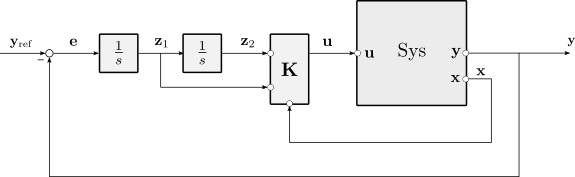
Optimal control. Reference tracking for ramp

Fig. 46.3 Caption#