Vectors using a Cartesian basis
Something more about vectors. After a brief general introduction, 2-dimensional vector spaces are investigated: Cartesian basis is defined, and used to write the component expressions of the main vector operations: 1) Multiplication by a scalar, 2) Sum and difference of vectors, 3) Scalar (or inner) product.
See:
Point-to-point distance
Using Cartesian coordinates, this is nothing more than the Pythagorean theorem. The distance of two points \(P_1 \equiv (x_1, y_1)\), \(P_2 \equiv (x_2, y_2)\), is the hypotenuse of the right triangle with catheti parallel to the Cartesian axes with length \(|x_2 - x_1|\) and \(|y_2-y_1|\). By Pythagorean theorem, the length of the hypotenusa, and thus the distance between the two points, is
\[d(P_1, P_2) = |P_2 - P_1| = \sqrt{(x_2-x_1)^2 + (y_2-y_1)^2} \ .\]
See:
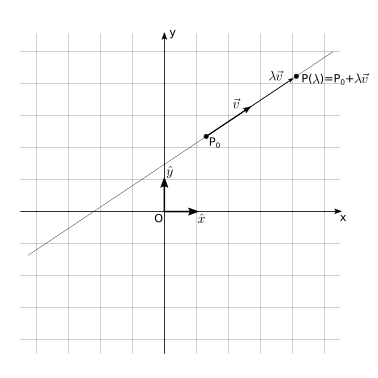
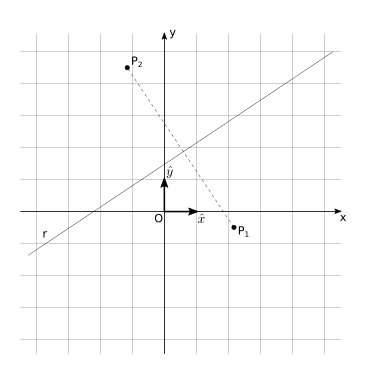
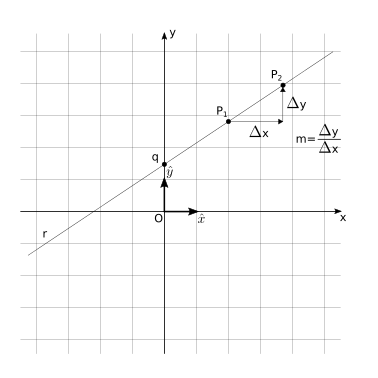
Lines in plane
Different equivalent definitions
- Point and direction (parametric equation)
- Points with the same distance from two given points \(P_1\), \(P_2\), using the definition of point-point distance (implicit equation)
- Point and slope (explicit equation)
All the details are provided in:
Conics in plane: circles, ellipses, hyperbola
The canonical form of the equations of circles, ellipses, and hyperbola can be easily derived using Cartesian coordinates just with the definition of point-to-point distance and a proper choice of the coordinate system. Only parabola is missing here, as it requires the point-to-line distance
This section only contains the conversion from the word definition to math. All the details - mainly boring algebra - are provided in
- Math: Analytical geometry: conics
- Math: Analytical geometry: conics: cananonical form with Cartesian coordinates
Circle. The points of the circle have the same (point-to-point) distance from the center of the circle, equal to the radius \(R\). Using Cartesian coordinates, the distance between points \(P \equiv (x,y)\) of the circle and its center \(C \equiv (x_C, y_C)\) is equal to the radius \(R\), or in math
\[d(P, C) = \sqrt{(x-x_C)^2 + (y-y_C)^2} = R \ ,\]
or, squaring, the equation of the circle with center \(C \equiv (x_C, y_C)\) and radius \(R\) reads
\[(x-x_C)^2 + (y-y_C)^2 = R^2 \ .\]
Ellipses. An ellipse can be defined as the geometric entity in the plane whose points have constant sum of the distances w.r.t. given points, the foci \(F_1\), \(F_2\), i.e.
\[|P - F_1| + |P - F_2| = 2 c \ .\]
Hyperbola. A hyperbola can be defined as the geometric entity in the plane whose points have constant difference of the distances w.r.t. given points, the foci \(F_1\), \(F_2\), i.e.
\[\left| |P - F_1| - |P - F_2| \right| = 2 a \ .\]
Here the absolute value is required on the right-hand-side, to represent both the branches of the hyperbola