This post grew out of a question about a structural mechanics exercise that appeared in a community of structural engineers. The exercise dealt with a hyperstatic beam system with elastic supports and thermal strains.
It’s a nice excuse to talk about the role of the weak form — especially compatibility and equilibrium conditions — and to show that the so-called energy theorems follow directly from choosing suitable test functions in the weak formulation.
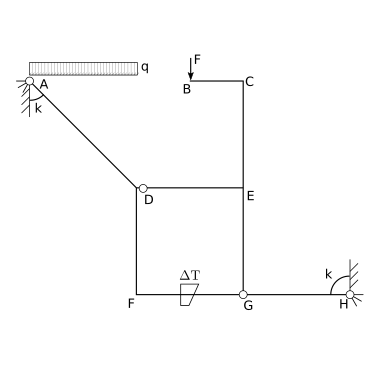
Linear elastic problem
\[\begin{cases} \boldsymbol\nabla \cdot \boldsymbol\sigma + \overline{\mathbf{f}} = \mathbf{0} && \text{in $V$} \\ \boldsymbol\varepsilon = \frac{1}{2} \left( \boldsymbol\nabla \mathbf{s} + \boldsymbol\nabla^T \mathbf{s} \right) \\ \boldsymbol\sigma = \mathbf{C} : \boldsymbol\varepsilon - \boldsymbol\beta \Delta T \\ \mathbf{s} = \overline{\mathbf{s}} && \text{on $S_D$} \\ \hat{\mathbf{n}} \cdot \boldsymbol\sigma = \overline{\mathbf{t}}_n && \text{on $S_N$} \\ \mathbf{K} \cdot \mathbf{s} + \mathbf{S} \cdot (\hat{\mathbf{n}} \cdot \boldsymbol\sigma ) = \overline{h} && \text{on $S_R$} \\ \end{cases}\]
Equilibrium conditions
Strong form
\[\begin{cases} \boldsymbol\nabla \cdot \boldsymbol\sigma + \overline{\mathbf{f}} = \mathbf{0} && \text{in $V$} \\ \hat{\mathbf{n}} \cdot \boldsymbol\sigma = \overline{\mathbf{t}}_n && \text{on $S_N$} \\ \end{cases}\]
with \(\boldsymbol\sigma = \mathbf{C} : \boldsymbol\varepsilon - \boldsymbol\beta \Delta T\).
Weak form
For every sufficiently regular test function \(\mathbf{w}\),
\[\begin{aligned} 0 & = \int_{V} \mathbf{w} \cdot \left\{ \boldsymbol\nabla \cdot \boldsymbol\sigma + \overline{\mathbf{f}} \right\} = \\ & = \oint_{\partial V} \hat{\mathbf{n}} \cdot \boldsymbol\sigma \cdot \mathbf{w} - \int_{V} \boldsymbol\nabla \mathbf{w} : \boldsymbol\sigma + \int_{V} \mathbf{w} \cdot \mathbf{f} = \\ & = \oint_{\partial V} \hat{\mathbf{n}} \cdot \boldsymbol\sigma \cdot \mathbf{w} - \int_{V} \dfrac{1}{2} \left( \boldsymbol\nabla \mathbf{w} + \boldsymbol\nabla^T \mathbf{w} \right) : \boldsymbol\sigma + \int_{V} \mathbf{w} \cdot \mathbf{f} \ . \end{aligned}\]
having exploited the symmetry of the stress tensor \(\boldsymbol\sigma\).
…
PVW
Compatibility conditions
Strong form
\[\begin{cases} \boldsymbol\varepsilon = \frac{1}{2} \left( \boldsymbol\nabla \mathbf{s} + \boldsymbol\nabla^T \mathbf{s} \right) && \text{in $V$} \\ \mathbf{s} = \overline{\mathbf{s}} && \text{on $S_D$} \\ \end{cases}\]
with \(\boldsymbol\varepsilon = \mathbf{D} : \boldsymbol\sigma + \boldsymbol\alpha \Delta T\).
Weak form
For every sufficiently regular test function \(\boldsymbol\Sigma\) (\(2^{nd}\)-order tensor)
\[\begin{aligned} 0 & = \int_{V} \boldsymbol\Sigma : \left( \boldsymbol\varepsilon - \dfrac{1}{2} \left( \boldsymbol\nabla \mathbf{s} + \boldsymbol\nabla^T \mathbf{s} \right) \right) = \\ & = \int_{V} \boldsymbol\Sigma : \boldsymbol\varepsilon - \oint_{\partial V} \hat{\mathbf{n}} \cdot \boldsymbol\Sigma \cdot \mathbf{s} + \int_V \boldsymbol\nabla \cdot \boldsymbol\Sigma \cdot \mathbf{s} = \\ \end{aligned}\]
if the tensor test function is symmetric \(\boldsymbol\Sigma = \boldsymbol\Sigma^T\).
Force method
Choosing the test function to be an equilibrated stress field — let’s define it as \(\boldsymbol\Sigma := \widetilde{\boldsymbol\sigma}\) to recall this condition — i.e. a stress field that satisfies equilibrium conditions
\[\begin{cases} \boldsymbol\nabla \cdot \widetilde{\boldsymbol\sigma} + \widetilde{\mathbf{f}} = \mathbf{0} && \text{in $V$} \\ \hat{\mathbf{n}} \cdot \widetilde{\boldsymbol\sigma} = \widetilde{\mathbf{t}}_n && \text{on $S_N$} \\ \end{cases}\]
under some external loads \(\widetilde{\mathbf{f}}\) in \(V\) and \(\widetilde{\mathbf{t}}_n\) on \(S_N\). The weak problem thus becomes
\[0 = \int_{V} \widetilde{\boldsymbol\sigma} : \boldsymbol\varepsilon - \int_{V} \widetilde{\mathbf{f}} \cdot \mathbf{s} - \int_{S_N} \widetilde{\mathbf{t}}_n \cdot \mathbf{s} - \int_{S_D} \hat{\mathbf{n}} \cdot \widetilde{\boldsymbol\sigma} \cdot \overline{\mathbf{s}} - \int_{S_R} \dots \]
```hvivhiscpi Example: evaluation of hyperstatics
One of the most common example of applications of force method is the evaluation of hyperstatic actions in over-determined structures.
```
PCVW
Choosing the test function to be the variation equilibrated stress field — let’s define it as \(\boldsymbol\Sigma := \delta \widetilde{\boldsymbol\sigma}\) to recall this condition — i.e. a stress field that satisfies equilibrium conditions
\[\begin{cases} \boldsymbol\nabla \cdot \delta \widetilde{\boldsymbol\sigma} = \mathbf{0} && \text{in $V$} \\ \hat{\mathbf{n}} \cdot \delta \widetilde{\boldsymbol\sigma} = \mathbf{0} && \text{on $S_N$} \\ \end{cases}\]
as the variation of given external loads \(\widetilde{\mathbf{f}}\) in \(V\) and \(\widetilde{\mathbf{t}}_n\) on \(S_N\) is identically zero. The weak problem thus becomes
\[0 = \int_{V} \delta \widetilde{\boldsymbol\sigma} : \boldsymbol\varepsilon - \int_{S_D} \hat{\mathbf{n}} \cdot \delta \widetilde{\boldsymbol\sigma} \cdot \overline{\mathbf{s}} - \int_{S_R} \dots \]